 FitPacer
Resolutions are not doomed to fail
We often hear that New Year's resolutions are pointless. Yet one American study followed, for six months, 159 people who had made a New Year's resolution and 123 others who wanted to change the same thing without committing to a date. Six months on, 46% of the first group were still keeping their resolution, compared with 4% of the second. What predicted success: confidence in one's ability to succeed and having prepared before 1 January.
So making a resolution helps. It just has to be one you can keep.[4]
"Do more" rather than "stop"
A large Swedish experiment followed more than 1,000 people for a year. The most common resolutions concerned fitness, weight and eating. After a year, 55% of participants felt they had kept theirs. Above all, those who set a goal to "do" something (move more, eat more vegetables) did better than those who wanted to "stop" something: 58.9% versus 47.1%.
"Walk ten minutes after lunch" is therefore more likely to last than "stop sitting all day".[5]
Mondays and 1 January: good springboards, if you stay modest
These dates matter. Researchers at the University of Pennsylvania showed that internet searches for "diet" and gym visits rise sharply at the start of a week, a month or a year, as if these landmarks gave a feeling of starting from scratch.
That drive is precious for getting started. But it fades fast, which is why the first step must be small enough to survive the following week, once the enthusiasm has gone.[6]
Ten minutes is already a lot
Small steps aren't just a psychological trick: they also matter for health. The World Health Organization puts it simply in its 2020 guidelines: any physical activity is better than none, and every minute counts.
An estimate based on US data suggests that if adults aged 40 to 85 added just ten minutes of moderate to vigorous activity a day, around 110,000 deaths could be prevented each year in the United States, nearly 7%. It is a projection, not a trial, but the order of magnitude speaks for itself. Along the same lines, an analysis of 15 studies covering more than 47,000 adults shows that the risk of death falls steadily as daily steps rise, well before the famous 10,000 steps.[7][8][9]
What a few minutes add up to in a year
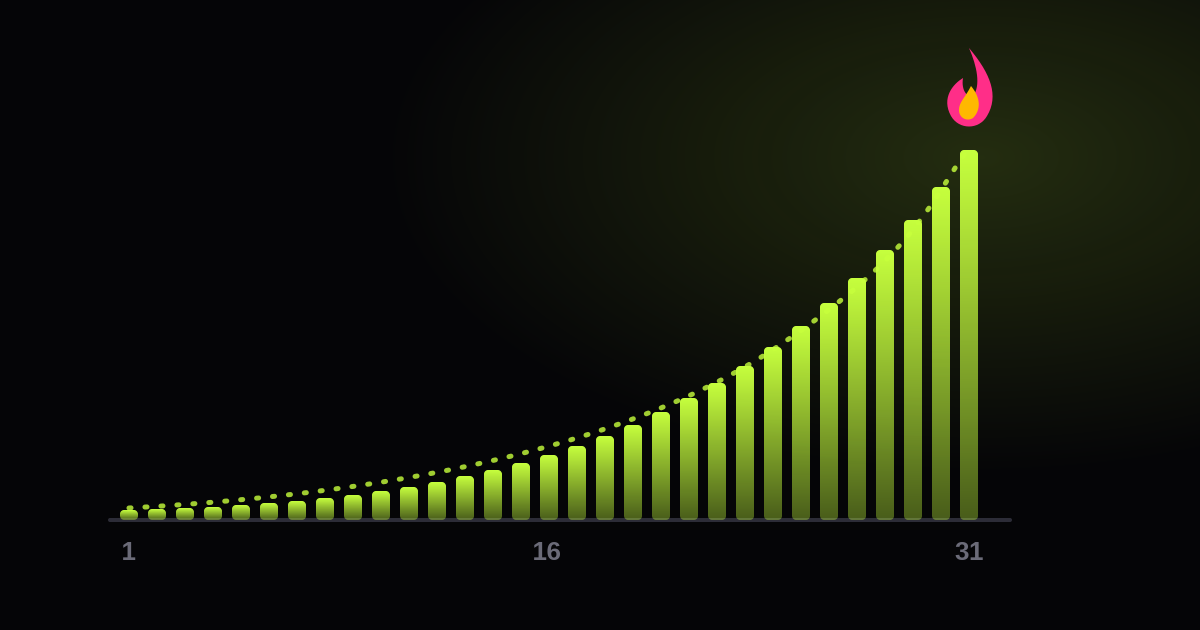
Ten minutes of walking a day is more than 60 hours of activity in a year. Three 4-minute Tabata sessions a week add up to about ten hours of intense effort over the year. And if you start with two minutes and add one minute each week, you'll reach a session of more than 50 minutes after a year, without ever making a sudden jump.
Build your first micro-adjustment
- Pick an action so short it feels almost silly: two minutes of stretching, one Tabata, a walk around the block.
- Hook it onto a moment that already exists: after your coffee, when you get home from work, before your shower. A habit forms through repetition in the same context; it takes a little over two months on average, and missing a day doesn't reset everything.
- Phrase it positively: "I do", rather than "I stop".
- Make your progress visible: a ticked box, a streak of days, a calendar filling up.
- Only step it up once the action has become automatic, and never by more than one notch at a time.
With FitPacer
- Short routines to start small: Tabata (4 minutes), the 7-minute workout or run / walk.
- "Done / not done" habits, with a reminder at the time of your choice, to hook a micro-adjustment onto your day.
- Your active-day streak and the calendar, to watch small steps add up.
- Once it has become easy, lengthen the routine by one notch: our guide "Set up and adjust your routine" explains how.
Keep in mind
These studies often rely on what participants report, and the health estimates remain projections. Yet they point to the same idea: a small effort kept up over time beats a big plan abandoned in February. If you have a health condition, talk to your doctor before taking up vigorous activity again.
Further reading
Official physical activity guidance is published by the World Health Organization, the NHS and the U.S. Department of Health and Human Services.[1][2][3]
Routines to get started
Read next
References
- World Health Organization. Physical activity (fact sheet). www.who.int/news-room/fact-sheets/detail/physical-activity
- NHS. Physical activity guidelines for adults aged 19 to 64. www.nhs.uk/live-well/exercise/physical-activity-guidelines-for-adults-aged-19-to-64/
- U.S. Department of Health and Human Services. Physical Activity Guidelines for Americans (current guidelines). odphp.health.gov/our-work/nutrition-physical-activity/physical-activity-guidelines/current-guidelines
- Norcross J. C., Mrykalo M. S., Blagys M. D. (2002). Auld lang syne: success predictors, change processes, and self-reported outcomes of New Year's resolvers and nonresolvers. Journal of Clinical Psychology, 58(4), 397-405. doi.org/10.1002/jclp.1151
- Oscarsson M., Carlbring P., Andersson G., Rozental A. (2020). A large-scale experiment on New Year's resolutions: approach-oriented goals are more successful than avoidance-oriented goals. PLOS ONE, 15(12), e0234097. doi.org/10.1371/journal.pone.0234097
- Dai H., Milkman K. L., Riis J. (2014). The fresh start effect: temporal landmarks motivate aspirational behavior. Management Science, 60(10), 2563-2582. doi.org/10.1287/mnsc.2014.1901
- Bull F. C. et al. (2020). World Health Organization 2020 guidelines on physical activity and sedentary behaviour. British Journal of Sports Medicine, 54(24), 1451-1462. doi.org/10.1136/bjsports-2020-102955
- Saint-Maurice P. F., Graubard B. I., Troiano R. P. et al. (2022). Estimated number of deaths prevented through increased physical activity among US adults. JAMA Internal Medicine, 182(3), 349. doi.org/10.1001/jamainternmed.2021.7755
- Paluch A. E. et al. (2022). Daily steps and all-cause mortality: a meta-analysis of 15 international cohorts. The Lancet Public Health, 7(3), e219-e228. doi.org/10.1016/S2468-2667(21)00302-9
- Lally P., van Jaarsveld C. H. M., Potts H. W. W., Wardle J. (2010). How are habits formed: Modelling habit formation in the real world. European Journal of Social Psychology, 40(6), 998-1009. doi.org/10.1002/ejsp.674
How this guide was written
Written by the FitPacer team from the sources above: official guidelines and published studies, each link checked. Numbers in brackets point to the source of each claim; practical tips are not presented as proven. This guide has not been reviewed by a health professional and does not replace their advice. Spotted a mistake? Report it from the app (Settings › Send feedback). Our editorial policy →
This content is for information only and does not replace advice from a health professional. If in doubt, ask your doctor before you start.